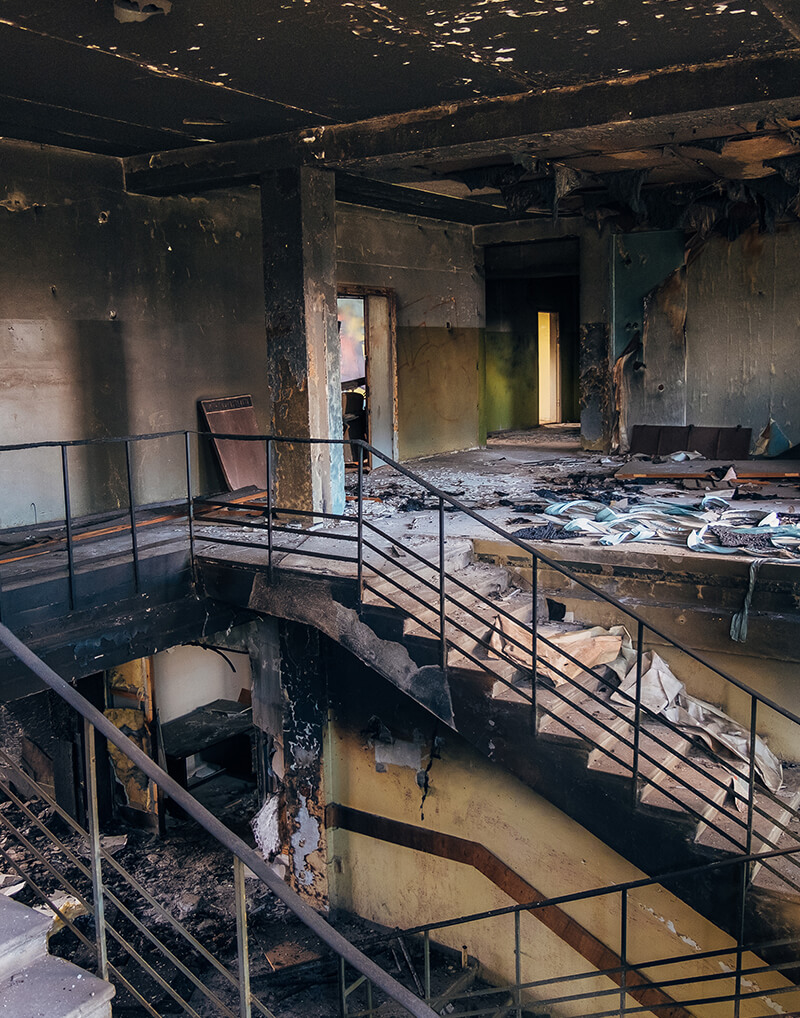
Fire and Flood Restoration: What To Do When Disaster Strikes

Building Repairs 14.06.22
fire flood second

Request a FREE QUOTE

If you’d like to discuss a project you have we’d love to help.

Contact us today for a free no-obligation quote.

Get a quote


Fire and flood restoration is one of our most emotive services. At a time when the worst happens to your building, you want to be surrounded by contractors who know what they are doing to get you back on track. 

Both fire damage and flood damage can have a debilitating effect on your business, preventing you from trading – so getting back up and running is a top priority. 

It’s often the first stages after fire or flood damage that can have the greatest impact on the speediness and ease of your restoration work. Read this blog to find out how you can ensure that you manage the time following a disaster with an efficiency that saves both time and money.

1. The Immediate Aftermath

The hours after discovering that your property has suffered fire or flood damage are crucial. Once your building is safe (it goes without saying that you should NEVER enter a building that is on fire), you need to contact your insurers. 

They’ll want to know the extent of the damage, what property was lost and whether you require alternative premises to work from while the fire and flood restoration works are carried out. Depending on your policy, you may have insurance cover that includes the cost of temporary workspace, but if you don’t you’ll need to think of a solution that enables you to continue working, be that working from home, short-term office rentals or a combination of the two.

Take many, many photos to document the damage, these will help you with your claim. A little forethought goes a long way when it comes to claiming for damaged goods – when you purchase expensive equipment, make sure you photograph the receipt so you always have a digital copy stored safely.

2. The First Steps

You’ll want to get your building back to its former glory quickly – and that’s where our fire and flood restoration services come in. At GI Sykes, our specially trained team of contractors will ensure that whatever damage your property has suffered, the remedial work is handled efficiently and with due care.

When you instruct us to help manage your recovery from flood or fire damage, our work begins immediately. We’ll send out someone to conduct an inspection to see what needs to be done. 

In the case of flooding, time is of the essence as any remaining water in your building will be causing further damage. If left, even for a short time, bacteria in the water can seep into the structure of your building causing long-term issues with things like mould and damp.


3. Getting To Work

Selecting a contractor to manage and oversee your fire and flood restoration project is an important task and one that must be done quickly. Using a reputable contractor that has vast experience in such problems means that you can be assured of a professional and reliable service. 

At GI Sykes, we work alongside your insurance company or loss adjustors to ensure that things are as simple and straightforward as they can be. Thanks to our outstanding reputation in handling stressful and sensitive restoration projects, we have found ourselves one of the go-to contractors for many leading insurance firms. We can assess the level of reconstruction needed in order to supply you with an estimated cost of repair.

Once the site is ready for us to start work, we begin with the process of clearing and salvaging what we can. 

In the cases of flood and water damage, your property may require further drying to ensure that there is no remaining water that can cause problems down the line. For this we use professional equipment to remove all moisture from the floor and walls.

In the case of fire damage, the structure of your building is closely inspected to see whether any walls, flooring or stairs are beyond repair and need to be removed. We also deal with the layers of soot that may be present. Soot is toxic, and if left too long on walls, furniture and floors, it can create secondary damage. Soot is also dangerous to inhale, so this job is really for the specialists.

4. Fast-Paced Work

We know that while your property is out of action, your business is likely suffering. We make every effort to keep your fire and flood restoration moving swiftly. From the initial clear out through to the last coat of paint – you need to know that your building will be habitable as quickly as possible.

This stage of your fire and flood restoration project will take the longest – it’s where your wreck of a building is transformed into a workspace once again. We project manage the whole shebang, so you don’t need to worry about electricians, decorators or carpet fitters – you just concentrate on managing your business the best you can while we take care of thing. 

You won’t be kept in the dark though. It’s important that you are kept updated with developments on site, so your project manager will debrief you regularly.

5. Preventative Action

As part of your fire and flood restoration works, we can build in some preventative measures to reduce the impact should disaster strike again. You might think that lightning doesn’t strike twice, but there have been cases where buildings have suffered a second disaster and been ill-prepared – don’t be one of them!

To protect your building against fire, we treat your walls and steel beams with intumescent coatings and fire protection coatings which increase the burn time of your building. This not only creates a longer evacuation window, it also gives the fire service more time to respond.

To protect against flooding, we can use specialist plaster on your walls, move electrical sockets higher and even install flood proof doors.


Fire And Flood Restoration: Do You Need Us?

If you’re looking for fire and flood restoration contractors, chances are you’re in a pretty stressful situation. Getting a reliable, fast-acting contractor on site and at work is as easy as calling 01384 891 341 or visiting gisykes.co.uk

Whether you’re dealing with flooding, fire damage or even criminal damage, we have decades of experience in restoring buildings and getting businesses back in action. 

Latest Articles

Previous
Next

Building Repairs – Damp Disasters And How To Avoid Them

Building Repairs 28.02.22
roof spraying 3

Request a FREE QUOTE

If you’d like to discuss a project you have we’d love to help.

Contact us today for a free no-obligation quote.

Get a quote

Building repairs are an expected part of owning or managing a building, but there are some building repairs that fill you with dread – not only because of the cost but because of the impact on your business or tenants. Damp is one of these. 

Damp in a building doesn’t always mean disaster. In some cases, rather than building repairs you just need to educate yourself and anyone using your building on how to avoid it. However, worst-case scenarios do need interventions – luckily at GI Sykes, we have a team of experts who can make the process simple with minimal disruptions. 

So, if you suspect damp problems in your building, read on to see what practical things you can do to avoid or fix it…


What is Damp?

According to the font of knowledge that is Wikipedia, ‘structural dampness is the presence of unwanted moisture in the structure of a building’. We’re yet to come across wanted moisture in the structure of a building, by the way! 

Damp can be categorised into two types; penetrating damp and rising damp. 

Penetrating damp is a result of water infiltration through an external wall into the property through a defect in the building or the external brickwork that has become porus. 

Rising Damp is the name given to the process of water in the ground climbing vertically through pores in the brickwork.


There is some controversy over the legitimacy of the term ‘rising damp’ (we know, the trade is overflowing with excitement). One expert, Stephen Boniface, once said ‘true rising damp is a myth’ which caused a bit of stir in the industry – although he did later clarify that he’d made the comment as a way to open up a seminar stating the opposite opinion with a big impact. 

Sadly his statement, while creating a buzz, was taken out of context and even now, more than a decade later, there are still blogs and articles citing this remark as evidence that rising damp doesn’t exist! (There’s probably a lesson in here about making sure your message is clear, but that’s for another day!)

Signs Of Damp

Some signs that you are in need of building repairs are obvious; cracks, uneven surfaces, dripping leaks – but what are the signs that your building has a damp problem?

A Musty Smell
Damp has a particular scent, it smells earthy like old mushrooms. If you notice a change in the aroma in your building, it is worth investigating further. 

Wet Walls And Windows

Condensation is a key indicator that building repairs are needed. Condensation happens when warm moist air inside your building comes into contact with a colder surface. Most properties will have a little condensation, bathrooms and shower rooms are notorious for it. But if you are seeing large patches of mould on your walls, ceilings or around the windows, you probably have a larger issue that needs resolving. 

If your walls look wet but don’t have water on the surface, there’s a chance the moisture is inside the wall itself. This is a sign of rising damp and will need urgent attention.


Warping Furniture

Damp particularly affects wood so, in cases of serious damp, we expect to see skirting and wooden furniture take in some of the moisture. This can result in bending and warping of the wood, and if left untreated, eventual rotting.

Causes Of Damp

So, now you can identify whether or not you have damp, what’s caused it in the first place?

Hot Air

The primary cause of superficial damp is too much moisture in the air. Hot showers, cooking and dry clothes on radiators are the usual culprits.

Drips

Small leaks from pipes can go on to create huge areas of damp. And as they’re small, the problem can go undetected for some time which means that by the time you notice, you may have a significant issue on your hands.


Gutter Defects

Damaged or wrongly installed guttering allows water to run down the walls, which over time, can lead to water ingress in your roof space and walls. While easily fixed with simple building repairs to the guttering, getting on top of this issue quickly is vital in reducing the larger problem of the damp.

Damp Course Problems

A missing, bridged or eroded damp proof course is usually the reason for rising damp. Groundwater is absorbed by the brickwork of your building, working its way upwards.


How To Avoid Dump?

Penetrative damp is fairly simple to remedy since the causes are environmental. Some changes to your habits and some building repairs, and your damp should be a thing of the past. To reduce the chances of damp problems or to prevent it from reoccurring, try the following:

Ventilation 

A flow of air around your building means that humid air is removed. You can start by opening your windows for a short while each day, but if that’s not enough to shift your damp ventilation systems can be installed to keep moisture at bay. 

Ensuring that furniture is away from the wall prevents moisture from getting trapped between the surfaces. This reduces the likelihood of damp and any building repairs that arise from that.

Keep The Property Warm

In an ideal world, you’d be able to keep a low heat in your building throughout the colder months as this keeps the walls warm so condensation can’t form. But with the way the energy market is, it’s not likely that anyone can afford round the clock heating. Instead having the heat on at intervals can achieve the same outcome – you just need to avoid the building becoming too cold. 

Building Repairs

Keeping on top of your building’s maintenance is essential if you want to avoid bigger problems in the future. If your guttering is damaged, wrongly fitted or even just clogged, getting that resolved is simple. At GI Sykes, we offer gutter maintenance that not only prolongs the life of your gutter but also protects against issues like damp. The same goes for roof repairs – a little investment in ongoing care means that you’re less likely to encounter costly problems down the line.

For rising damp issues, you’re going to need specialist help in inspecting the cause of the damp. While there are some temporary measures you can put in place to reduce the effects of rising damp, you will need to resolve the root cause. We’re happy to help you understand your damp problem better, just give us a call to arrange a no-obligation chat.

Got Damp?

If you suspect that you need building repairs to stop damp, then get in touch. We have a specialist team of contractors who can identify the causes of your damp and provide quick, efficient solutions.


Latest Articles

Previous
Next

Got a Project in mind?

If you’d like to discuss a project you have we’d love to help.

Contact us today for a free no-obligation quote.

Get a quote