3 Things To Consider When Choosing Your New Industrial Flooring

Building Construction 14.02.23
walkways 2

Request a FREE QUOTE

If you’d like to discuss a project you have we’d love to help.

Contact us today for a free no-obligation quote.

Get a quote

Many businesses don’t realise they’ve got the wrong industrial flooring fitted until something goes wrong. Wear and tear, damage and uneven surfaces create a hazardous working environment. Leaving you and your business exposed to risk.

Whether your industrial space is a factory, manufacturing unit or engineering facility, your floors will be subjected to heavy footfall bringing with it dirt, bacteria and dust. As well as accidental spillages of liquids, such as oil, can be difficult to clean and cause irreversible damage.

That’s why your industrial flooring needs to match the specific requirements of your business. The correct flooring should be tough, hygienic and safe. Ensuring your investment lasts for longer, creating an easy-to-clean space and helping to prevent slips, trips and falls.

The 3 Most Important Things To Consider When Investing In Industrial Flooring


1. The Function Of Your Space

What happens within your space will have a direct bearing on the type of industrial flooring you should choose. Does it need to prioritise hygiene? Will it be supporting the weight of heavy machinery? Do lots of liquids get used?

The types of industrial flooring available are…

  • Epoxy Resin (including self-levelling)

An epoxy floor will give you exceptional durability, is easy to maintain and can be enhanced with non-slip and decorative finishes. Epoxy resin has incredible strength and can withstand high impact, making it a brilliant choice for busy and hygienic working environments.

  • PU Resin

Polyurethane resin is a softer substance than epoxy, but it is still extremely heavy-duty and hard-wearing. PU resin flooring has great chemical and organic acid resistance to corrosion, and is a superb choice for spaces where leakage or spillage of these substances might be expected.

  • Polished Concrete

Often used in areas where there is heavy equipment, polished concrete flooring is almost impossible to damage because of its incredible strength. The sealed finish is resistant to chemical corrosion, and its smooth surface makes it easy to keep clean.

  • Vinyl

Vinyl flooring comes in many designs, colours and finishes enabling you to add some character and style to your industrial flooring. It’s easy to install, durable, waterproof and slip-resistant. Making it a good option for commercial safety flooring where footfall is high and regular cleaning products are used.

  • Rubber

The properties of rubber flooring make it more cushioned than other options and an ideal industrial flooring solution if people are standing for long periods of time. It’s easy to clean, antimicrobial, sustainable and offers a good grip to help people stay on their feet.


2. How Much Maintenance Will Your New Industrial Flooring Need?

Every type of industrial flooring will need regular maintenance to keep it in tip-top condition. Helping to ensure they remain safe, functional and looking great.

The type of maintenance required will depend on the flooring you’ve installed, but all flooring will benefit from regular sweeping and mopping, using the recommended detergent, to keep dirt and debris at bay.

If your flooring had a sealant or anti-slip coating applied, it’s important this is reapplied as advised to prevent corrosion and staining, and potential safety risks.

Regular upkeep of your industrial flooring will help it last for longer, but on average…

  • PU resin flooring lasts 10 years.
  • Epoxy resin flooring lasts 10-20 years.
  • Vinyl flooring lasts 10-20 years.
  • Rubber flooring lasts 20 years.
  • Polished concrete flooring lasts up to 100 years!

3. Do You Need Zones?

The large open space of industrial spaces often needs to be divided into different zones, and depending on the use of a zone you may require different types of industrial flooring.

For example, if you have a manufacturing zone with heavy machinery, you might consider polished concrete for its super weight-bearing strength. Whereas, softer rubber flooring may be a better choice for a packaging zone where employees stand beside a conveyor for long periods of time. Or a bright-coloured vinyl could illuminate an area with little to no natural light.

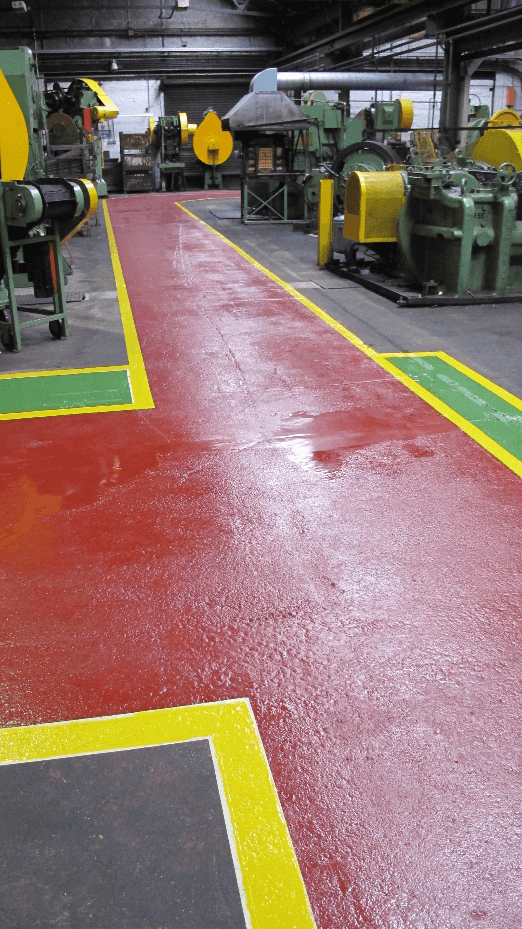
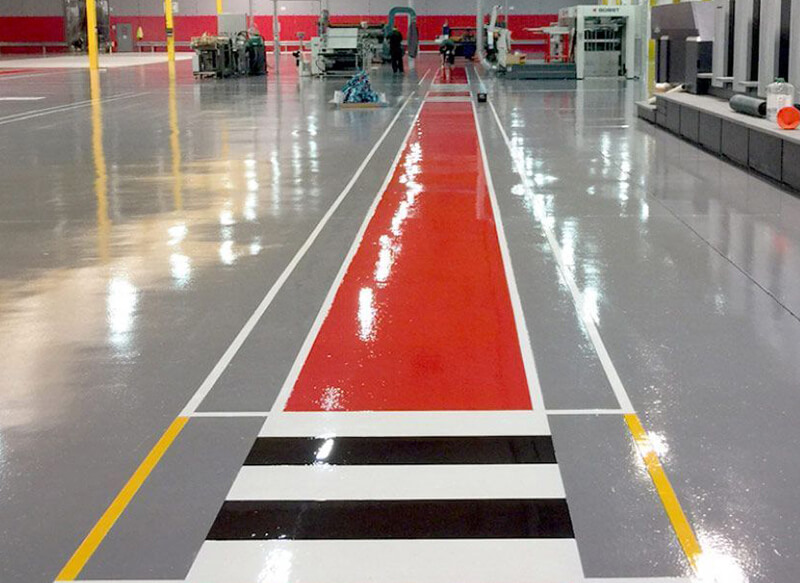
Industrial flooring can also be used effectively to make a clear visual definition between zones, highlight hazardous areas and create walkways. You can read more about that in our blog post about walkways and internal line marking here…


Other Things To Consider

Affordability

The cost of your industrial flooring will depend on the type you choose and the space it has to cover. If you’re on a tight budget vinyl flooring is a cost-effective option, however it’s worth remembering that it may need to be replaced sooner than more expensive flooring solutions such as rubber or polished concrete.

Disruption

If your industrial space is a new build, this shouldn’t be an issue, but when business is already up and running, you probably won’t have the option to shut down for long in order to have your new flooring installed. To overcome this rubber and vinyl could be laid in sections, whereas polished concrete, epoxy and PU resin flooring should be poured in its entirety to prevent joint lines.

How quickly your industrial flooring will take to be able to walk on depends on its type…

  • Epoxy and PU resins – typically 12-24 hours.
  • Vinyl and rubber – approx. 24 hours.
  • Polished concrete – up to 48 hours after the concrete pour.

Health & Safety

When you’re selecting your industrial flooring, you need to ensure that it meets the necessary health and safety standards and requirements. This will help to protect you should anything go wrong.

Non-slip options or additional coatings are a fantastic choice to help prevent avoidable accidents, and antimicrobial solutions can help to keep nasty bugs and bacteria from spreading. Ensuring a happy, healthy and productive workforce.

For more information on antibacterial coatings click here…

Selecting Specialist Flooring Experts Will Ensure Your Industrial Flooring Is Up To Standard

Don’t be floored by flooring!

We’re here to help.

With over 50 years of commercial contracting experience, knowledge and skills, GI Sykes knows a thing or two about industrial flooring.

We’ll make sure that you select the right product for your property, and our expert team of flooring specialists will install it to the highest standard to give you total peace of mind for years to come.

For a FREE consultation and quotation for your industrial flooring, please get in touch.

Latest Articles

Previous
Next

Could Suspended Ceilings Work Well For Your Commercial Building?

Building Construction 21.12.22
industrila painting

Request a FREE QUOTE

If you’d like to discuss a project you have we’d love to help.

Contact us today for a free no-obligation quote.

Get a quote

Been looking up suspended ceilings? Wondering if they’d work well in your commercial building? Well, you’re in the right place to find out. In this blog, we’ll see what makes suspended ceilings ideally suited for workspaces and what other options are available.

What Is A Suspended Ceiling? 

First things first, what is a suspended ceiling? Even if you don’t know, you will have walked under hundreds of them throughout your life – they’re in most retail, education, healthcare and office environments. 

Suspended ceilings, also known as dropped ceilings and false ceilings, are most commonly made from a metal frame that forms a grid. Tiles are placed into each square to create a secondary ceiling that sits below the surface above.

The Benefits Of Suspended Ceilings

There’s good reason as to why most commercial buildings opt for a suspended ceiling… Because there are so many benefits. If you’re looking to refurb your commercial property and are thinking about ceilings, you’ll want to look at this list.

Quick Installation

If you’ve been updating your office, warehouse or retail unit, then time is of the essence when getting things finished. And that’s where a suspended ceiling can help keep your project to task. A whole ceiling can be finished quickly, making it one of the most convenient options when refitting or renovating a property.

Good At Concealing

That gap between the concrete ceiling and the suspended tiles isn’t dead space. It’s ideal for hiding the plethora of ducts, cables and pipes that a commercial building usually has. With a suspended ceiling, those ducts, cables and pipes are not only tucked away out of sight, with some suspended ceilings, they’re also freely accessible should you need to replace or repair them.


Flexibility With Design & Lighting

That same cavity above your ceiling tiles means you can design your lighting to suit the use of the space below. Need extra lighting above your checkouts? No problem. Want specific areas zoned? Then use different coloured tiles to give a clear indication. And the best bit is that is really simple to change at a later date!

Sound Proofing

Sound can really travel in big, open spaces, so if you have a space with an upstairs neighbour or your building has multiple floors, you’ll benefit from a ceiling that can help reduce noise. The gap between the top of the room and the ceiling tiles will help to lessen noise, but if you want maximum peace, then acoustic pads or panels can be added.

Acoustic pads and panels have been designed to block noise travelling through ceiling tiles. They’re ideal for open offices, units in shared spaces and workspaces that need a greater level of quiet and calm.

Affordable

Suspended ceilings are the most affordable option on the market. The materials aren’t expensive, and installation is quick, so it is a surprisingly cost-effective ceiling solution. 

Fire Resistant 

Ceiling tiles must adhere to British legislation and provide fire protection. Most tiles offer passive fire protection (they help delay the spread of fire) for between 30 – 60 minutes. You can opt for tiles and ceiling treatments that have a longer burn time if you want additional peace of mind.

A Lighter Space

A white suspended ceiling is excellent at bouncing light around a space, so if your room is a bit on the dark side, then a suspended ceiling can help brighten it up.

A suspended ceiling can have up to 0.86 light reflectance, which means the tiles can reflect 86% of all light back into a room. This can help reduce your lighting costs, as well as create a more tranquil environment with a better distribution of natural light.

Improve Energy Efficiency

Speaking of reducing bills, did you know that a suspended ceiling can also help bring down your heating costs too? There are two ways it can help; firstly, the lower ceiling means that you’re heating less space overall, so you reduce the heat needed to keep your property warm. 

The second is by adding ceiling insulation. Available as pads that are placed above the ceiling tile, these encapsulated wads of fibre stop your heat from escaping upwards. If you want to get better control of your energy bills (and let’s face it, who doesn’t?), adding an insulating layer is a good idea.

What Are The Different Types Of Suspended Ceiling Available?

Concealed Grid

This is when the metal framework sits behind tiles that meet edge-to-edge. The finished look is more high-end, with a continuous expanse of uninterrupted ceiling. 

Gypsum Board

Gypsum board – also known as plasterboard – is used in suspended ceilings when a smooth finish is preferred. It can be plastered to give a seamless finish.

Exposed Grid

This is the most inexpensive type of false ceiling. We install a metal grid and place ceiling tiles on the cross-hatched metal. When you look at the ceiling, you’ll see a tile framed by metal.

So, Could Suspended Ceilings Work For Your Commercial Building?

Based on the above, it’s hard to see how any other option can deliver as many benefits whilst also being so cost-effective. If your business premises needs a neat, tidy ceiling that helps to create a safe place for your ducts and cables, provides flexible lighting configuration, a great range of colour options, adds thermal efficiency AND improves your fire protection, then suspended ceilings should be your first choice. 

At GI Sykes, we have decades of experience installing suspended ceilings for all manner of commercial properties. Our specialist team can get your new ceiling up and ready with minimal disruption to your day. Just get in touch to arrange a no-obligation quote, and we’ll be happy to help you decide if a suspended ceiling is right for you.

Latest Articles

Previous
Next

The Pros & Cons Of Epoxy Floor Coating

Building Construction 27.07.22
Floor coatings 2

Request a FREE QUOTE

If you’d like to discuss a project you have we’d love to help.

Contact us today for a free no-obligation quote.

Get a quote

Weighing up the pros and cons of epoxy floor coating? Then this is the best blog for you. We’re going to take a close look at all of the benefits and drawbacks of this popular floor treatment.

As epoxy floor coating specialists, we have vast experience and there isn’t much that we haven’t dealt with or come across! So read on to see what we think makes it the ideal solution for many floors – and why it might not be for you…

What Is Epoxy Floor Coating?

Before we get to the good stuff, let’s first make sure you know what exactly epoxy floor coating is and what it’s commonly used for. 

In simple terms, epoxy is a type of resin floor system that hardens to create a solid coating, much like plastic. This coating bonds well to appropriate base layers, making it well suited to high-traffic areas.

Where Is Epoxy Floor Coating Best Used?

Industrial and commercial flooring benefits most from the durability that epoxy offers. The common floors that we treat are; 

  • Warehouses
  • Factories
  • Areas for machinery and vehicles
  • Walkways
  • Public buildings
  • Care homes
  • Showrooms

But this is not an extensive list – at GI Sykes, we have used epoxy floor coating in so many locations, we can’t list them all.

The Pros Of Epoxy Floor Coating

We’re not going to pretend that we’re not huge epoxy flooring fans – we even have it in our own facilities. But we do like to make sure we give an unbiased overview of the product so you’re more informed. We’re going to start with the key advantages of using epoxy coating on your floors.

Protection For Your Floor

While a little obvious, it’s the main reason people opt for epoxy as a floor coating. The thick layer of resin protects your floor like nothing else. 

Extremely Durable

There are different types of epoxy, and as with anything, the quality of the product plays a large part in its longevity. We only use trusted brands that deliver exceptional results and many of the epoxy floors we have applied are still going strong many years later. With the correct base, careful application and ongoing maintenance, your epoxy floor coating can last up to ten years.

Easily Applied

Epoxy flooring is one of the most convenient flooring solutions in terms of downtime for your property. Our team of professionals can quickly apply the coating and once it’s cured – you’re back in business.

No Skidding
Despite its glossy appearance epoxy floor coatings can reduce skidding if the right type is used – so fewer slips and trips!

Hygienic

One of epoxy resin’s superpowers is that it can be made to be antimicrobial. This makes it ideal for buildings that work with food, medical facilities or places where bacteria and germs need to be kept to a minimum. Even standard epoxy flooring offers a high level of hygiene and it’s non-porous and smooth, making it easy to keep clean.

Affordability

Epoxy floor coating is one of the most affordable flooring options on the market. Compared with alternative flooring choices, such as rubber, concrete or PVC, epoxy flooring is the best value.

Colour Options

You can even have your flooring coloured to match your company brand – epoxy floor coatings can be custom coloured if you are looking to reflect your brand or environment. Many businesses, particularly warehouse and industrial ones, colour code their flooring to denote areas of hazard or safety. Red flooring is ideal as an additional warning of hazards like moving vehicles, chemicals or other dangers, while green or blue work well for marking out walkways and safe zones.


The Cons Of Epoxy Floor Coating

With such a long list of benefits to epoxy flooring, you might be wondering what the disadvantages could possibly be! And although it is a shorter list, it’s important to know the drawbacks so you can make an informed decision for your building. 

Slippery When Wet
Ok, we know we said it’s anti-skid, but some epoxy coatings can be more slippery when they’re wet. If you know that your floor is going to be frequently wet, then you can take a couple of approaches. You can use a different floor covering in that area or, if you still want the benefits of epoxy, you can either have an additive mixed in, like grit, that creates a rough surface or we can use a specialist roller that leaves the surface textured.

Preparation Plays An Important Role
The durability and longevity of your flooring depend heavily on the quality and reliability of your base. Making sure that the floor that is being covered is clean, damage-free and prepared for the coating is one of the most important jobs. If damage is discovered or if the floor needs a deep clean to remove grease or oil, then this can extend the project. 

Maintenance Required

You can leave your epoxy floor coating to its own devices – but it’s not recommended. Ensure that your floor is regularly cleaned – but don’t reach for the Flash just yet. Epoxy flooring can build up a ‘haze’ over time when soap-based cleaners are used, there are specialist liquids you can buy to ensure your floor keeps its shine. A weekly vacuum and dust are also advised as this keeps grit to a minimum and prevents scratches and gouges. 

Hard To Remove

This is a big one to consider. If you think that you might want to remove your epoxy flooring in the future, then think carefully about having it installed in the first place. Epoxy floor coating is tricky to remove once applied and may even require a whole new floor!

Want To Know More About Epoxy Floor Coating?

So now you’ve heard the pros and cons. Hopefully, this has helped you come closer to deciding if an epoxy floor coating is right for your property, but if you’re still left with questions, then our team are more than happy to help. You can call 01384 891 341 or  click here to arrange a call-back.

Latest Articles

Previous
Next

5 Ways Commercial Builders Can Save You Money

Building Construction 30.06.22
Jase checking drawing

Request a FREE QUOTE

If you’d like to discuss a project you have we’d love to help.

Contact us today for a free no-obligation quote.

Get a quote

When it comes to commercial builders, there’s a lot that can be offered to your building project to help to reduce your costs. And if you’re planning a building renovation or construction, keeping a keen eye on your budget is a significant aspect of your project management.

At GI Sykes, we pride ourselves on our ability to offer our commercial building clients a stellar service that can be relied upon to be as cost-effective as possible. But you don’t just need to take our word for it, we’re going to explain five ways that commercial builders can save you money…

1.We Get Better Rates

Given that we build commercial premises all day, every day it is no surprise that we get better rates on materials than even some of our fellow commercial builders. And with over 58 years in business, we have a robust network of suppliers that allow us to achieve great costs for the materials we use.

The global pandemic, the rising costs of fuel, Brexit, extreme demand and various industrial strikes have led to the cost of materials soaring to an all-time high. And now we have to factor in energy price hikes into the cost of production, it’s not looking likely that that will change anytime soon. A good commercial builder will utilise their supplier network to get the best rates on materials possible, and here’s the important bit, pass that saving on to their client. 

Some commercial builders see the opportunity to increase their revenue by retaining the difference in materials, while others will help to bring down the cost of a project by passing their great rates on.

2. Work Fast. Work Smart

Typically, commercial builders tend to have a larger workforce. We have a huge team of contractors that are directly employed by us (many use sub-contracted staff who don’t always offer consistency in skill and dedication). 

When we take on your commercial build, we have a large pool of experienced and qualified contractors we can select from to work on your project. We match those with the most relevant skills to your project, so we know that it will be expertly handled from the get-go.

Things like ill health, problems with other projects and sub-contractor shortages won’t affect the pace of your project, because we have the resources to deploy alternative team members when necessary. With smaller, non-commercial builders there’s a danger that your project timeframe can overrun due to unexpected issues. This not only delays the opening of your building, which can cause you a loss of earnings, but you may also even still incur charges for the missing days.

Our project timelines aim to be as rapid as possible, with every necessary trade pre-booked to ensure that it runs on time and in budget.


3. Reliable Workmanship

We hold all of our employees to a high standard of workmanship and as a result, we have an outstanding reputation as reliable and quality commercial builders. 

Sadly, within the construction industry there are instances of clients falling prey to so-called ‘rogue traders’. These unscrupulous contractors often cut corners and use sub-par techniques and materials, and often the poor workmanship doesn’t show until months down the line when it can become difficult to get a resolution. We’ve even heard horror stories where entire buildings have needed to be razed to the ground due to shoddy and dangerous construction.

Thankfully, these stories are few and far between, but carrying out a thorough investigation of your proposed commercial builders is always a good idea. At GI Sykes, we’re approved by some of the construction industry’s leading awarding bodies, such as CHAS, SafeContractor and Constructionline, which reassures our clients that not only have we been carefully vetted by different organisations, but that they also have recourse if something goes wrong (not that this has ever happened!).

There’s truth in the adage; ‘pay cheap, buy twice’, so make sure you don’t lose money by investing in a poor choice of commercial builders.


4. Futureproof

All of our work carries a long guarantee – and you can be assured that we’ll always be around to see it through. Another sad fact that has arisen from the recent stresses on the industry is the closure of many construction firms. Some have fallen foul of the hard times created by the turbulent labour market, others due to the financial strain that the pandemic and supply chain issues have put them under. 

Wherever the reason, if your commercial builders go out of business, you lose any assurance that their guarantees are provided. Ultimately that means you may end up footing the bill for any repairs or remedial work on your building that occurs in the future. 

GI Sykes is a generational business that has survived through many turbulent times – our company structure ensures that we’ll be here for another 58 years – at the very least!

5. Project Management 

A standard factor in any of our construction projects is the inclusion of a dedicated project manager. This is an appointed team member who is there to advocate for you throughout your building work. 

From the initial planning to the day-to-day management, through to the signing off, your project manager is there to work on your behalf. As part of our team, they’ll be able to direct and work closely with our commercial builders, but as your representative on-site, they’ll ensure that everything keeps to schedule and help overcome any unexpected events.

This careful management of your construction work helps keep a tight rein on timings and budget, saving you hours of stress and the risk of spiraling costs.


Commercial Builders: A Savvy Investment

So, if you are weighing up the pros and cons of using commercial builders, the above should help you make an informed choice. Using a commercial construction company for your building projects should not only give you peace of mind about the quality of your build, but it should also keep your costs down. 

To talk to us about your prospective building projects, please visit www.gisykes.co.uk and arrange for one of our commercial building experts to contact you.

Latest Articles

Previous
Next

7 Things to Look For In A Building Contractor

Building Construction 20.12.21
Richard outside

Request a FREE QUOTE

If you’d like to discuss a project you have we’d love to help.

Contact us today for a free no-obligation quote.

Get a quote

Choosing a building contractor can be difficult. We’ve all heard about contractor nightmares on TV or from friends – cautionary tales about bodge jobs done by cowboy builders that leave buildings without a roof for months on end or worse. 

Luckily there are some great building contractors out there and if you know what to look out for then you’ll be able to find someone who’ll get your project completed on time and to a high standard. 

Here’s our top 7 things to look for in a building contractor…


1: A Long, Proven Track Record

A proven track record is a great sign that the building contractor will deliver on their promises. Once you have a building contractor in mind, find out how long they’ve been in business and ask if they can provide testimonials.

By doing this, you can understand their experience in the industry and learn more about the experience their past customers have had working with them. 

2: Transparent Quotes

Your quote should be clear, complete and easy to understand. Always ask for a quote to come in writing (usually by email) and not just be agreed verbally, as this gives you some backup if you need to query anything later on. 

Included in the quote should be:

  • Exactly what will be completed in the project. 
  • Whether materials are included or not.
  • What is NOT included.
  • Fees clearly explained ie. VAT or extras.

Including all of this in the quote protects your interests and prevents any confusion further into the project. A clear, comprehensive quote is also a sign that you’re dealing with a professional contractor. 

3: Insurance

Insurance is a must for any project. But be sure to check that your building contractor has comprehensive insurance that covers the type of work they’re completing for you too. 

The biggest red flag is a contractor without any public liability insurance. Insurances don’t just protect the contractor, they make sure you have a system of redress to follow if things go wrong or accidents happen. Protecting you, your property and even your people.


4: Speedy Response Time

You want to see signs of good customer service from the outset – a speedy response time is a good indicator of how you’ll be treated as a customer.

Does a contractor take weeks to reply to your first emails and calls? This could be due to poor customer service or because they are simply too busy for you or don’t have the organisational skills that you need in a contractor. 

Look for someone that replies quickly to your enquiries, gives full answers to your questions and seems to be happy to help you understand the needs of your project. 

5: Accreditation

Accreditation is a certificate of sorts. It’s proof that your contractor has trained specifically to work to particular standards. But even if you’re not that interested in the specific certifications, accreditation shows that the contractor is serious about what they do and can meet high standards. 

There are lots of accreditations different building contractors may have. The most common ones include:

  • ISO accreditations, like the ISO 9001 and ISO 4001, which ensure quality customer service and environmental management systems respectively
  • CHAS, proof of good health and safety processes

The more accreditations, the better as it means they have trained to these standards. And if you have specific interests, like environmentally friendly building, accreditations can help you select the contractor that fits your requirements perfectly.


6: More Than A One Man Band

Before you make your final decision on a building contractor, think about whether you want to work with a one-man band or a business with a bigger team.

Both options have their bonuses and drawbacks, but if you have an important or commercial project to get started on, an established contractor with a team could be right for you.

A team will have access to more people, more resources and a wider range of expertise. With a bigger team on hand, you’ve also got less chance of long downtimes. 

Imagine if your one-man band contractor fell ill and you had to hit pause on the job for a few months? You’d wish there was a larger team that could come in and continue work.

7: Honest Answers

This might seem obvious, but honest answers help you pick a building contractor you can really trust.

When you ask your contractor a question, you don’t want to hear confusing arguments or feel like they’re holding back advice. Clear communication is key to any project big or small, which is why honesty is so important in a contractor.

The Ideal Building Contractor Is…

Ideally, your chosen building contractor should be able to prove their track record with testimonials and case studies, give clear quotes with fast response times, and show up with accreditations and insurance.

A larger contractor might be better suited to your project if it’s important that you stay on schedule or for commercial projects, but most of all make sure you find a contractor you can trust.

GI Sykes has worked hard for over 55 years to tick all of these boxes so our clients know the job will get done – and it’ll get done right. If you’d like to talk to us to find out if we’re the right contractor for you, just get in touch here. 

Latest Articles

Previous
Next

Got a Project in mind?

If you’d like to discuss a project you have we’d love to help.

Contact us today for a free no-obligation quote.

Get a quote